Adoniram Judson: Father of Baptist Missionaries
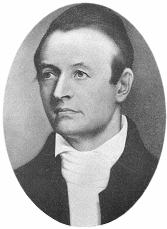
| American Baptist missionary, lexicographer, and Bible translator to Burma. Born in Massachusetts in 1788. Helped form the American Baptist Missionary Union. In 1834 completed a translation of the whole Bible into the Burmese language. During the Anglo-Burmese War, he spent twenty-one months in prison. From 1845-1847, after thirty-four years in Burma, he took his only furlough to his native land. Returning to Burma, he spent his remaining years working on his English-Burmese dictionary. He died in 1850 and was buried at sea. |
By whatever measurement you measure the man Judson — the measurement always is the same — he was a mighty man!
Mentally — he was mammoth. He read at the age of three years, took navigation lessons at ten, studied theology as a child, entered Providence College (now Brown University) at seventeen — despite the fact he spent one year of his youth out of school in sickness — and he was a "veritable bookworm." Also, he mastered the Burmese language (possibly the most difficult language to acquire, excepting Chinese), writing and speaking it with the familiarity of a native and the elegance of a cultured scholar, and he also translated the Bible into Burmese. His biographers believe that his translation was "undoubtedly his greatest contribution to the people among whom he chose...to spend and be spent for Christ's sake."
Spiritually — he was superlative. Despite the fact his father was a Congregational preacher, and in spite of his mother's "tears and pleadings," Judson was not saved until he was 20 years of age. He had become a confirmed deist — due largely to the influence of a brilliant unbeliever in college who set out to win Judson to his deistic faith, and succeeded.
But, incredibly, Judson's conversion to Christ was due in large measure to that same deist. After graduation Judson left home to become a wanderlust. One night in a country inn his room was adjacent to the room of a dying man. The moaning and groaning of that man through the long night permitted Judson no sleep. His thoughts troubled him. All night questions assailed his soul: "Was the dying man prepared to die?" "Where would he spend eternity?" "Was he a Christian, calm and strong in the hope of life in Heaven?" "Or, was he a sinner shuddering in the dark brink of the lower region?" Judson constantly chided himself for even entertaining such thoughts contrary to his philosophy of life beyond the grave, and thought how his brilliant college friend would rebuke him if he learned of these childish worries.
But the next morning, when Judson inquired of the proprietor as to the identity of the dead man, he was shocked by the most staggering statement he had ever heard: "He was a brilliant young person from Providence College. E______ was his name."
E______ was the unbeliever who had destroyed Judson's faith. "Now he was dead -- and was lost! Was lost! Was lost! Lost! Lost!" Those words raced through his brain, rang in his ears, roared in his soul — "Was lost! Lost! Lost! There and then Judson realized he was lost, too! He ended his traveling, returned home, entered Andover Theological Seminary and soon "sought God for the pardon of his soul," was saved and dedicated his life to the Master's service!
His conversion not only saved his soul, it smashed his dreams of fame and honor for himself. His one pressing purpose became to "plan his life to please his Lord." In 1809, the same year he joined the Congregational church, he became burdened to become a missionary. He found some friends from Williams College with the same burden and often met with them at a haystack on the college grounds to earnestly pray for the salvation of the heathen and petition God to open doors of ministry as missionaries to them. That spot has been marked as the birthplace of missions in America.
Three years later, February 19, 1812, young Adoniram Judson, and his bride of seven days, Ann Haseltine Judson, set sail for India, supported by the first American Board for Foreign Missions. But on that voyage, Judson, while doing translation work, saw the teaching of immersion as the mode of baptism in the Bible. Conscientiously and courageously, he cut off his support under the Congregational board until a Baptist board could be founded to support him!
The Judsons were rejected entrance into India to preach the Gospel to the Hindus by the East India Company and after many trying times, frustrations, fears, and failures, they finally found an open door in Rangoon, Burma.
There was not one known Christian in that land of millions. And there were no friends in that robber-infested, idolatry-infected, iniquity-filled land. A baby was born to alleviate the loneliness of the young couple, but it was to be only for a temporary time. Eight months later, Roger William Judson was buried under a great mango tree. The melancholy "tum-tum" of the death drum for the thousands claimed by cholera, and the firing cannons and beating on houses with clubs to ward off demons, tormented the sensitive, spiritual souls of that missionary couple, too.
And there were no converts. It was to be six, long, soul-crushing, heart-breaking years before the date of the first decision for Christ. Then, on June 27, 1819, Judson baptized the first Burman believer, Moung Nau. Judson jotted in his journal: "Oh, may it prove to be the beginning of a series of baptisms in the Burman empire which shall continue in uninterrupted success to the end of the age." Converts were added slowly — a second, then three, then six, and on to eighteen.
But opposition came, also. Finally Judson was imprisoned as a British spy — an imprisonment of twenty-one months. Judson was condemned to die, but in answer to prayers to God and the incessant pleadings of his wife to officials (one of the most emotional-packed, soul-stirring stories in evangelism), Judson's life was spared and finally British intervention freed him from imprisonment.
The work progressed and gospel power began to open blind eyes, break idolatry-shackled hearts and transform the newly-begotten converts into triumphant Christians. On April 12, 1850, at the age of 62, Judson died. Except for a few months (when he returned to America after thirty-four years from his first sailing), Judson had spent thirty-eight years in Burma. Although he had waited six years for his first convert, sometime after his death a government survey recorded 210,000 Christians, one out of every fifty-eight Burmans! It was a partial fulfillment and a monument to the spirit and ministry of the man, who at Ava, the capital city, gazed at the temple of Buddha and challenged, "A voice mightier than mine, a still small voice, will ere long sweep away every vestige of thy dominion. The churches of Jesus Christ will soon supplant these idolatrous monuments and the chanting devotees of Buddha will die away before the Christian's hymns of praise."
Aye, a mighty man of faith, prayer, purpose, patience and perseverance for the Son of God and for souls, was Adoniram Judson!
+Used with permission. From Profiles in Evangelism by Fred Barlow, Sword of the Lord Publishers, ©1976.
>> More Adoniram Judson